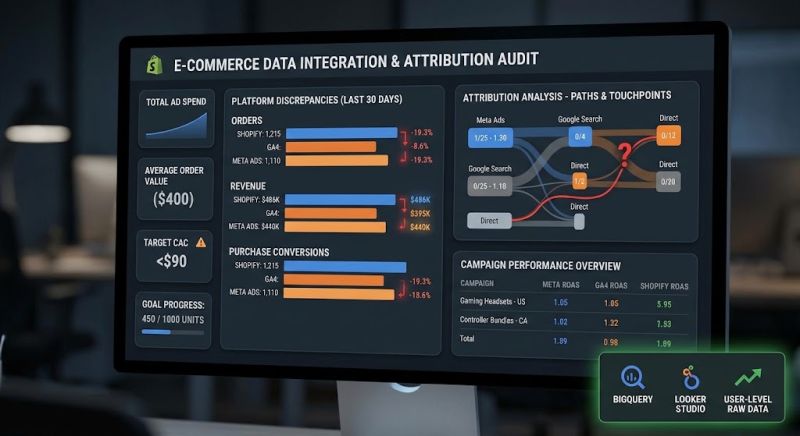
An e-commerce store on Shopify. Meta shows one traffic and purchase number, GA4 shows another, Shopify shows a third. When you're earning five times what you're spending, nobody cares.
Then the economics start to tighten. You need to hit a target, turn off weak campaigns, scale the strong ones. And you have nothing solid to decide on: unclear how many people came, unclear how many bought.
That's the situation I walked into. The client: a DTC store on Shopify, based in Australia, selling primarily to the US, running paid on Meta and Google Ads. They sell gaming devices at an average order value of $300–500, with a target CAC under $90. They were working toward a goal of 1,000 units per month. And their data was messy, diverging across every system.
I started with a thorough audit, as usual. Found several things:
1. Shopify tracking. The platform has tightened its restrictions significantly in recent years – sandbox mode for checkout and a pile of limitations. Tracking users became harder, and there were errors.
2. Conversion API – data delivery to Meta. Issues with parameter passing and deduplication. Easy to miss at first glance.
3. Most importantly: all decisions were being made on aggregated data from ad accounts and analytics tools. Averages across the board.
The proposal was straightforward: stop making decisions on aggregates and start working with raw data – down to the individual user and individual purchase. To do that, build a proper data warehouse. I recommended BigQuery, with a visualization layer on top – we put together a Looker/Data Studio dashboard quickly.
Simple setup. But it requires a detailed audit upfront – and that's the whole point.
What the team got: several dashboards – accurate, fast-updating, where the numbers actually reconcile with real sales and ad spend. One of them cohort-based. In e-commerce, cohorts are non-negotiable: they're how you evaluate funnel health and retention.
Now they can see in real time which campaigns are pulling up and which are dragging down. Turn off the weak ones, scale the strong ones – momentum toward target. Decisions got faster and more accurate, and the team stopped living inside Excel exports and manual report joins.
The takeaway: e-commerce needs detailed analytics – down to the individual user and purchase. And the tricky part is that off-the-shelf solutions don't give you that granularity out of the box. If your data doesn't add up – don't start tweaking attribution models. Start with an audit. After that, you can build out the dashboard however you want – Claude included.
Want a stronger data analyst role or a raise? Grab the FREE Product Analyst Playbook and get the exact roadmap to your next offer.

