Here’s how analytics work often goes.
A stakeholder asks why leads dropped last week.
You open GA4, BigQuery, three dashboards, an old SQL query, a Google Doc with metric definitions, and Slack, where the real context is buried in a thread.
Two hours later, you still don’t have an answer.
You have tabs.
OpenAI released a new Data Analytics plugin for Codex, and I spent some time testing it.
What stood out: Codex can now act more like an analytics operator inside your workflow.
It can:
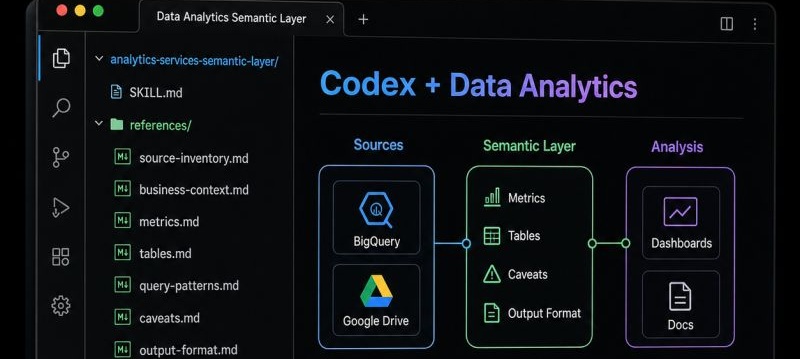
- connect to BigQuery, Drive, docs, dashboards, spreadsheets, and local files
- use business context through semantic layers
- diagnose metric movements
- design KPIs and measurement plans
- build reports, charts, dashboards, and source-backed recommendations
- keep track of definitions, caveats, table grain, joins, and source-of-truth rules
The setup is simple:
- Connect your sources: BigQuery, GA4 exports, GSC exports, Google Drive, spreadsheets, dashboards, SQL files, docs.
- Create a semantic layer: describe the business area, key metrics, schemas, joins, caveats, source-of-truth rules, and preferred output format.
- Pick one real workflow: not a toy prompt. Give it an actual analytics task: “Diagnose why leads dropped last week.” “Analyze the funnel and recommend what to fix.” “Build a KPI framework for this product area.”
- Check the assumptions: review sources, filters, grain, definitions, and caveats.
That’s where it becomes useful: when it has enough context, and when the output is reviewed with real analytical discipline.
Analysts should pay attention.
If your work is mostly pulling numbers, reusing queries, making recurring reports, explaining dashboards, stitching context from docs, or turning vague questions into structured analysis, the floor is moving.
Fast.
The uncomfortable part: analytics work becomes much easier to hand off when an agent understands the business context, metrics, and source systems.
Writing SQL is becoming less of a moat.
Knowing which question is worth answering is becoming more valuable.
So yes, maybe it is time to worry a little.
Mostly, it is time to upgrade what we think analytics work is.
I’m still testing it, but I can already see where this goes.
Want a stronger data analyst role or a raise? Grab the FREE Product Analyst Playbook and get the exact roadmap to your next offer.

